Introduce
Molecular contamination is a matter of concern in the IAQ fields as well as in industrial processes. Odor treatment is the most recognizable method first in the requirement to treat molecular pollution.. Water treatment systems, industrial plants near residential areas are a matter of concern and concern. to environmental management regulations if these factories are not interested in "odor treatment" measures. A treatment plant and wastewater collection system, chemicals or enzymes can be used to reduce odors in wastewater. Today's mechanical improvements to appliances also reduce odors. When liquid phase treatments are not exhaustive, a gas phase treatment system is needed for application.
This article will discuss odorants and guide a preliminary assessment to determine a course of action. The most common odor that we can easily see is sewage treatment stations and tanks in factories. Therefore, the processing devices are proposed to apply for this processing purpose. The article also presents the odor treatment method that is especially interested in the application of Activated Carbon, which is widely used, easy to apply and economical.
The Cause of Odor
Substances that contribute to the generation of odors in the atmosphere are usually inorganic or organic compounds in the gaseous state. formed from microbial activity on waste products. The reported bad odors released from wastewater treatment tanks include: mercaptan, skatole, indole, inorganic acids, aldehydes, ketones and organic compounds containing the element nitrogen or sulfur molecules. These substances originate from anaerobic degradation of high-molecular-weight compounds, especially proteins.
Among inorganic compounds, ammonia and hydrogen sulfide are considered to be the main causes of odors (household sewer odors).
Common odor levels in the air are given in the following table:
Table 1: Odor levels of some substances in the surrounding environment
| ||||
Odor treatment methods
Vapor odor treatment can offer the following three options:
- Gas absorption by liquid, chemical oxidation.
- Gas treatment by thermal oxidation, combustion.
- Gas adsorption by solid materials.
Gas absorption by liquidis the process of transferring gaseous components from the gas phase into the liquid phase through the process of dissolving gases in the liquid when they come into contact with each other.
Absorption is divided into two main types: physical absorption without chemical interaction is a reversible process and chemical absorption - between them there is a chemical reaction to produce another substance (absorption).
Commonly used absorbents include: Water (H2O), basic solutions: KOH, NaOH, Na2CO3, K2CO3, Ca(OH)2, CaCO3,... MonoEtanolAminA HOCH2CH2NH2), Dietanolamine (R2NH), triethanolamine (R3N)
.jpg)
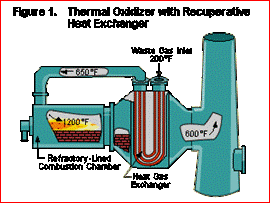
Odor treatment by incinerationalso known as after-burning, can use a direct flame or use a catalyst. This method is often applied in the case of large emissions but very small pollutant concentrations, especially organic compounds with very unpleasant odors.
Processes that are generally suitable for incineration applications are evaluated as:
Heavy odor pollutants are either combustible or chemically changed to a less odorous substance.
- Gas lines with particles (particles) that can be seen, such as smoke from coffee roasters, smoked meat production, roasting spring rolls...
- Some organic gases, direct exhaust vapors will react with smog causing harm to the environment. Incineration will decompose these substances effectively.
- Some technologies such as mining and oil refining emit combustible gases and very toxic organic compounds. Incineration is an effective and safe method when using a direct flame to burn directly on the chimney or in a separate combustion chamber.
Gas adsorption by solid materials is an application based on the attraction (affinity) of gas and vapor molecules (adsorbate) by the surface of a solid (adsorbent). Application of adsorption method to clean gas with small content of gas and vapor impurities. In industry, adsorption is often carried out to clean and dry the air, separate gas or vapor mixtures into individual components, and conduct heterogeneous catalysis on the surface of phase division.
Solid forms commonly used to treat air pollution include activated carbon, zeolite, synthetic polymers and others such as silica gel, activated aluminum applied to highly reducing gas streams.

Solid Material Adsorption Method- Activated Carbon
Activated carbon has been used since the early 1950s. This method gives very high efficiency for organic gases and some inorganic gases. Recently, activated carbon is also being expanded and improved. carbon characteristics as well as new absorption filtration systems.
Application absorption systems for the treatment of odors and low pollutant concentrations (<10ppm) are relatively simple. In this case, the carbon material will be removed when saturated, called a non-return filtration system.
In the case of highly soluble vapors (from 10 to 10,000 ppm) a reconstituted absorption system must be used. Because the system uses a large amount of activated carbon. The reconstituted system includes the following types: fixed-bed, rotating-bed and fluidized-bed systems. Depending on the case, they have different advantages and disadvantages.

Activated Carbone” Adsorbent"
Setting the physical properties of the carbon material will affect the absorption capacity, absorption rate and also the pressure drop when the gas flows through the material layer. The physical properties of carbon compared to some other sorbents are given in table 2 above.
It is generally understood that a material with a larger surface area has a higher absorption capacity. But the surface area must be valid in terms of effective adsorbent pore sizes. Pores in activated carbon are classified into micropore, macropore and transition pore. Micropores with a diameter of 10 to 100 Angstroms or less, pore diameters greater than 1,000 Å, and pores between 100 Å and 1,000 are transitional.
Adsorption between gaseous and solid:
According to the law of gases, molecules will move from an area of high concentration to an area of low concentration. Gas molecules will enter and distribute through the pores of the material called diffusion. The rate of diffusion increases with increasing temperature. Diffusion is rapid for smaller carbon particles because the large outer surface is easily accessible. Once the gas molecules have entered the pores they will move chaotically (Brownian).
The molecules will inevitably collide with the inner surface of the material. The molecule will be trapped by a weak force called physical adsorption, the adsorption force is the Van der Waals force, which is the reversible interaction of the attractive forces between the molecules of the solid and that of the adsorbed substance. The adsorption process is completely reversible. Basic carbons are physically adsorbent (this is Broad Spectrum) and they are adsorbed to a very wide range of vapors and gases (see appendix table at the end of the article).
.png)
Some particles are too light or volatile to be trapped inside the material. With these gases, the surface of the material can be chemically treated in the manufacturing process to increase the adhesion performance. These chemical treatments will react and interact strongly with the pollutant molecules to form chemisorption. (Camfil makes these under the names impregnated carbon, impregnated aluminas, impregnated zeolites and ion exchange materials.).
Ion exchange materials are porous polymer structures made from vulcanization of styrene divinylbenzene.

Coefficients Affecting Process System Characteristics:
Material Selection: The pore size in a material depends on the material and the manufacturing method. Materials with multiple micropores are suitable for adsorbing small molecules, while mesoporous materials are suitable for larger molecular adsorption. Macropores are of little value in molecular capture, but they play a role in diffusion
The material is also related to the surface area in contact with the gas, which in turn is related to the contact time and the resistance of the gas flow when passing through the material layer. The material is a parameter to determine the cross-sectional area of the device containing the material as well as to determine the required depth of material layer.
Temperature: Basic carbon material properties are very sensitive to temperature. When the temperature increases, the gas molecules move faster, the particles that have been stopped are easily ejected from the surface of the material, the condensed particles will move in the direction of the gas phase. Normally for basic carbons by physical absorbance (Broad Spectrum) the system should limit the operating temperature to 40oC.
For intensive materials or according to chemical absorption (chemisorbed media), as the temperature increases, the absorption efficiency increases. Then the diffusion efficiency and the reaction between the pollutant molecule and the absorbent will increase rapidly. (Intensive carbon can be applied to temperatures above 100 oC for nuclear power plants, treating waste water odors with temperatures from 40 – 50 oC, in household waste odor treatment systems. temperature 80_90 oC.).
Gas to be treated If there is a concentration of dust particles in the air stream to be treated, the absorption performance will be lost quickly. Therefore, before treating the gas phase odor, it is necessary to equip a pre-filter system to prevent coarse dust particles (particles).
The efficiency and life of the filter media depends on the inlet gas concentration in the treatment system. When the gas concentration is extremely low, the absorption ability on the surface of the material is very weak and vice versa. The diagram showing the absorption efficiency expressed between the mass of the pollutant gas and the absorbent material is called the isothermal diagram (see diagram below).
In addition, there are many factors affecting the absorption efficiency such as: pressure, air flow relative humidity, air flow velocity, contact time, etc.
Activated Carbon Absorption Systems
Non-Renewable Absorption System
Non-reversible systems are manufactured in a wide variety of configurations. Usually they consist of thin layers of absorbent material in the range 10mm to 100mm. Therefore, the gas flow through this thin layer will have a very low pressure drop of less than 60Pa depending on the thickness of the layer, the wind speed and the size of each type. Normally, the object velocity is designed in the range of 0.1 to 0.3 m/s. The shelf life ranges from 6 months (strong smell) to 1 year. The non-regenerating system is used to filter the air with small flow such as offices, air conditioners and odor-producing exhaust gases such as laboratories, medicine storage rooms, etc.

The absorbent layers are usually plate, cylindrical or corrugated and are called filter plate, filter cartridge and filter cartridge. Small particles contaminated with carbon are arranged in the porous layer of the material, which is usually a metal mesh or filter paper.
The non-reversible system is also designed with a very thick layer of material. A deodorizer as shown below has the shape of a cylinder, inside is filled with filter material, the carbon mass is up to a few hundred kilograms. This equipment usually treats small amounts but high concentrations of contamination (3m3/min) from collection tubes of laboratory benches, chemical storage tanks or chemical reactors.
Reconstituted Absorption System
The reduction system can take the form of a fixed-bed, moving-bed, and a fluidized-bed. The name of each type of system is based on the method of contact between the gas flow and the material. The selection of a suitable system should be based on the contaminant to be removed and the method of material recovery.
Fixed-bed absorption system
Used to absorb various organic vapors and vaporize at low pressure. The system is well applied where the liquefied organic vapors do not mix with water, they are separated based on the difference in densities between water and these organic liquids.
The fixed-bed system will consist of 2 beds or more beds arranged parallel to each other. When one bed works, the remaining beds perform the conversion process as well as prepare for the next filter cycle. A fixed-bed diagram like the one below.
Based on the design drop pressure, a fixed-bed system usually has a material layer thickness of 300mm to 1.2 meters and a maximum diameter of 1.2 meters. The optimum air velocity when passing through the filter media is usually in the range of 0.1 to 0.5 m/s. The pressure drop through the system ranges from 750Pa to 3,750Pa depending on velocity, material thickness and carbon particle size.
.png)
Moving-bed system
The carbon layer can be used more efficiently than the fixed-bed system because the pollutant air flow only passes through the unsaturated carbon layer, the gas flow through the material layer is shorter, so the pressure drop is much lower.
The rotating carbon-fiber absorber layer system uses carbon fiber arranged in the baffles. The filter media is suspended on a rotor that rotates at 1-9 rpm. Return by hot air through the baffle when rotated to position.
The processes of absorption and desorption take place simultaneously on different parts of the rotor. Vapors released during desorption will be 5 to 15 times more concentrated than the incoming gas stream, so they can be adsorbed and condensate before being burned.
Another form of movable bed is the wheel zeolite adsorber. This wheel is arranged in the vertical direction and rotates at a speed of about 5 rpm. Three-quarters of the biscuits work while the other quarter does the steam release with hot air passing through. The VOC in the exhaust gas stream has a concentration 10 to 15 times higher than the treatment gas concentration and the flow is only about 1/10 of the treatment stream. The overall efficiency of the device is in the range of 90% to 98%.
Fluidized bed absorption system is divided into two chambers: one for absorption and one for desorption. Contaminated air flows into the absorption chamber from below through the layers of material, creating an artificial boiling form for these layers. So the gas and the material are in good contact, then filtered will escape at the top. Filter media will move from the top down, when reaching the bottom of the chamber they are transported aerodynamically to the steam release chamber. The steam release chamber uses the hot gas at the combustion chamber of the steam released in the steam release chamber. The filter media that can be used is polymeric or activated carbon which has good wear resistance properties (beaded type is preferred rather than granular). This type of carbon granules is now manufactured suitable for this application.
Contact technical support and quotation:
Mr. Huy: 0988.408.134 or email: thtech.huy@gmail.com.